Model / Intercept
Counter-drone response time study
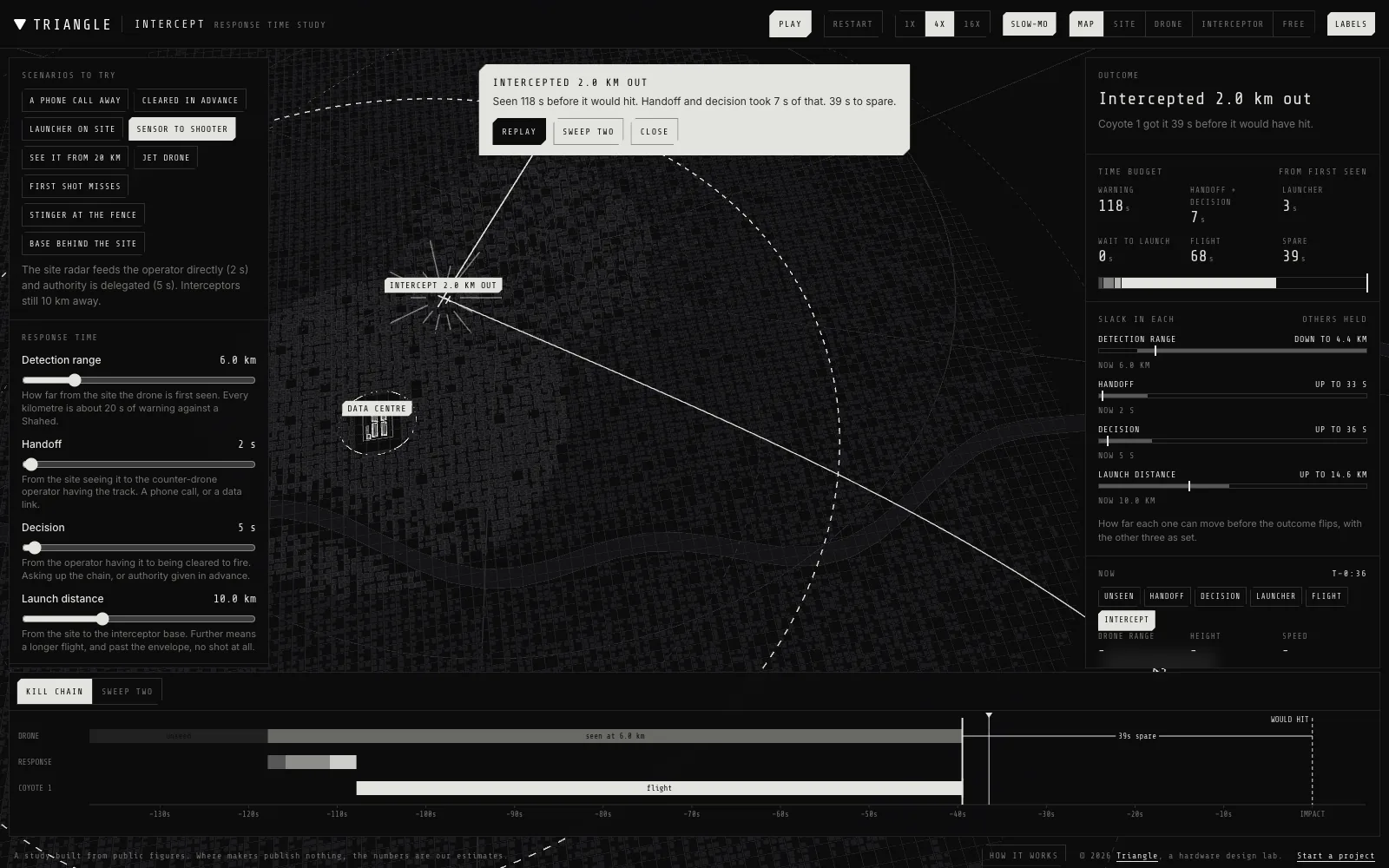
One attack drone flies at a data centre in a made up US city. The site sees it on radar, the track goes to an operator, the operator is cleared to fire and an interceptor flies out. Four numbers decide it: detection range, handoff, decision and launch distance.
Run itintercept.triangle.info
What it is
The drone is a Shahed-136 or the jet Geran-3. The interceptor is a Coyote Block 2, a Roadrunner-M or a Stinger. The drone flies straight and level, then dives at the roof, which is fair for a drone that flies on GNSS and INS and does not manoeuvre.
Move any of the four and the whole engagement solves again at once. The page shows the time budget, how far each number can move before the outcome flips with the other three held, and a heat map of the margin over any two. Click a cell and the run takes its values.
What it found
- With a 6 km sensor, a 60 s phone call and a 90 s clearance, the drone hits, even with a Coyote base 10 km away. The launcher is ready 35 s after impact, and it needs 11.7 km of detection to work.
- Fixing one step is not enough. Clearing the launch in advance fails while the handoff is still a phone call, and moving the launcher on site fails too: it does not buy back the people's time.
- Link the sensor to the shooter, 2 s of handoff and 5 s of decision, and the same radar and the same base intercept 2 km out with 39 s to spare.
- A better sensor can stand in for a slow chain. Seen from 20 km, with the phone call and the clearance still in place, the drone is stopped 7.9 km out with 154 s to spare.
- The jet drone beats the linked chain. At 340 km/h, seen at 6 km, it is out of reach of a Coyote 10 km off to the side. It has to be seen from 7.8 km.
How it is built
Written from scratch in TypeScript and three.js. An engagement solves in 5 to 25 ms at 200 Hz, which is why the limits and the sweep can run live in the page. Interceptors are point masses on textbook proportional navigation. Closest approach is found inside each step, so a kill does not depend on the step size, and every scenario is flown headless and checked against a finer step before release.
The numbers
The city and the site are made up. Clutter and low flight are folded into the detection range. The drone and interceptor figures are public ones, and makers publish little: Roadrunner-M has no published speed or range, and turn rates and reaction times are not published for any of them, so those numbers are the lab's estimates. Not affiliated with any maker.
Run it at intercept.triangle.info