Model / Intake
Supersonic intake study
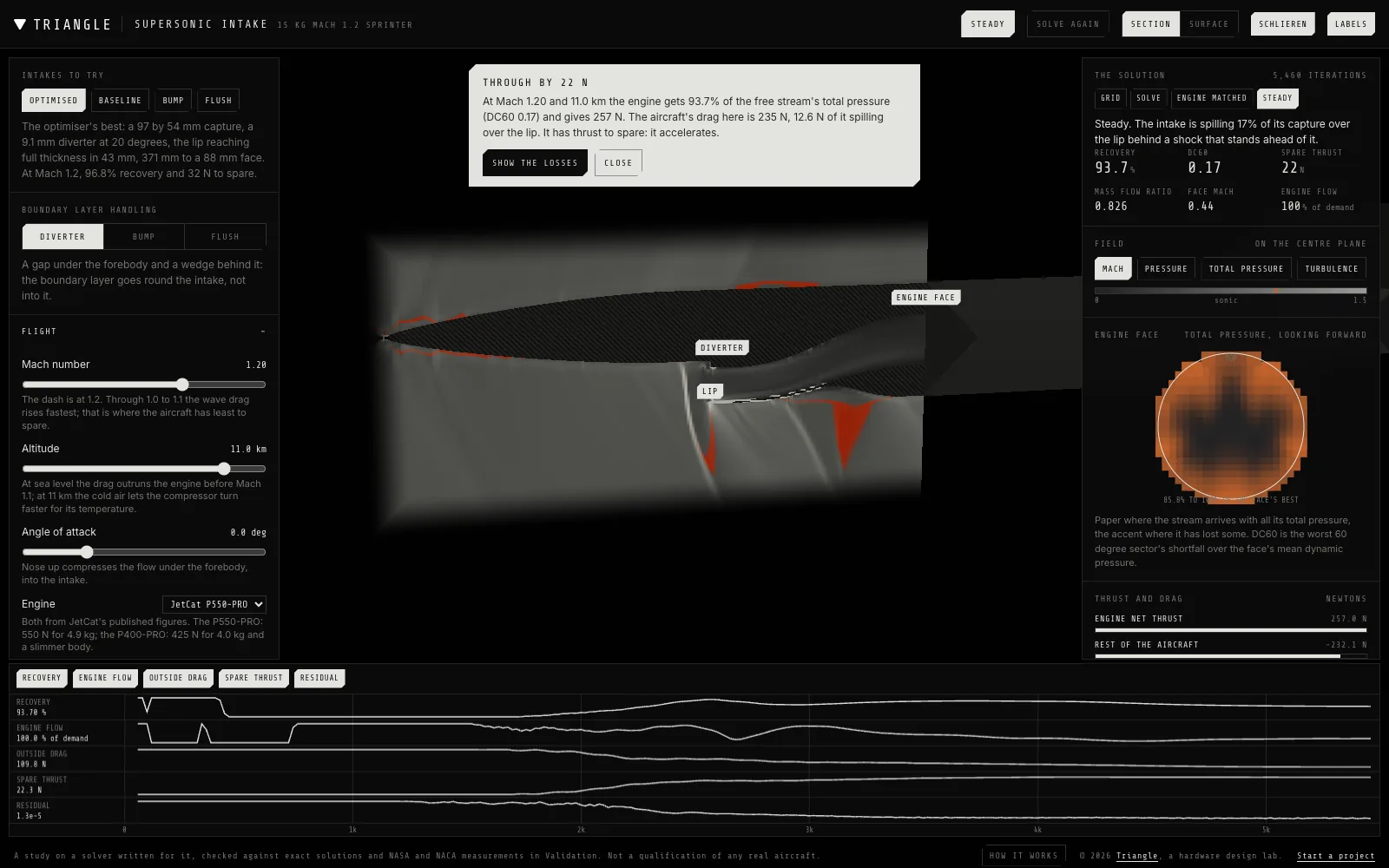
The ventral intake and S-duct of a 15 kg jet that has to break the sound barrier on a JetCat P550-PRO. A compressible flow solver written for the study runs on your graphics card, holds the engine's flow at the face, and shows the recovery, the distortion, the spillage and the thrust left over.
Run itintake.triangle.info
What it is
The brief is a dash of 10 to 20 seconds at Mach 1.2, on an intake that is cheap and passive: printed or hand laid, with nothing that moves. It has to be low in drag through Mach 1 first and efficient second. The intake sits under the forebody and turns up 60 mm through an S-duct to the engine.
Pick a diverter, a bump or a flush intake, set the Mach number, altitude and angle of attack, and the page solves the flow from a fresh start. The engine is matched off design from JetCat's published figures, and the rest of the aircraft's drag comes from a handbook build up, so every result ends as a force balance: through by so many newtons, or short.
What it found
- It breaks the sound barrier at altitude, not at sea level. At sea level the drag outruns the engine before Mach 1.1. At 11 km it has about 33 N to spare at Mach 1.2 and tops out near Mach 1.28.
- The optimised intake wins through the sound barrier, not at the dash. From Mach 0.9 to 1.1 it gives 1.3 to 2.5 points more recovery, 3 to 9 N more to spare and a quarter of the distortion. At Mach 1.2 the extra spillage from its larger capture cancels the gain.
- The search promised 7 N at Mach 1.2 on 3 mm cells. Solved again on 2 mm cells, that gain was gone.
- A diverter beats a bump at these speeds. A bump at Mach 1.2 barely compresses the flow and hardly moves the boundary layer. Swallowing the boundary layer saves 7 N of drag and costs 2.5 points of recovery.
- The intake decides a few newtons; the airframe decides tens. The uncertainty in the aircraft's own wave drag is worth more than any intake choice here.
- The first optimisation exploited a fault: air leaking through the lip where it was thinner than a cell. The unit cases had not shown it. It was fixed and everything was run again.
How it is built
Written from scratch in TypeScript on WebGPU: a shock capturing finite volume solver with Spalart-Allmaras turbulence and a wall function, on a cut Cartesian grid. The optimised design came out of the same solver, run headless.
Four of the six validation cases pass: a shock tube, a ramp, a cone and the additive drag of a spilling intake. Two fail, and both stay on the page. Skin friction on a flat plate reads 4 to 12% high at 2 mm, and NASA's S-duct stays attached where the experiment separates, reading recovery about 1.5 points high. So the optimiser is held to ducts milder than NASA's.
The numbers
The figures above are on 2 mm cells at 11 km. The page starts on 4 mm cells so it solves in a browser, and reads lower: 93.7% recovery and 22 N to spare at Mach 1.2, against 96.8% and 32 N. The aircraft is a generic one, its drag an estimate. This is not a qualification of any real aircraft.
Run it at intake.triangle.info