Lab / Studies / Vehicle
Vehicle optimiser study
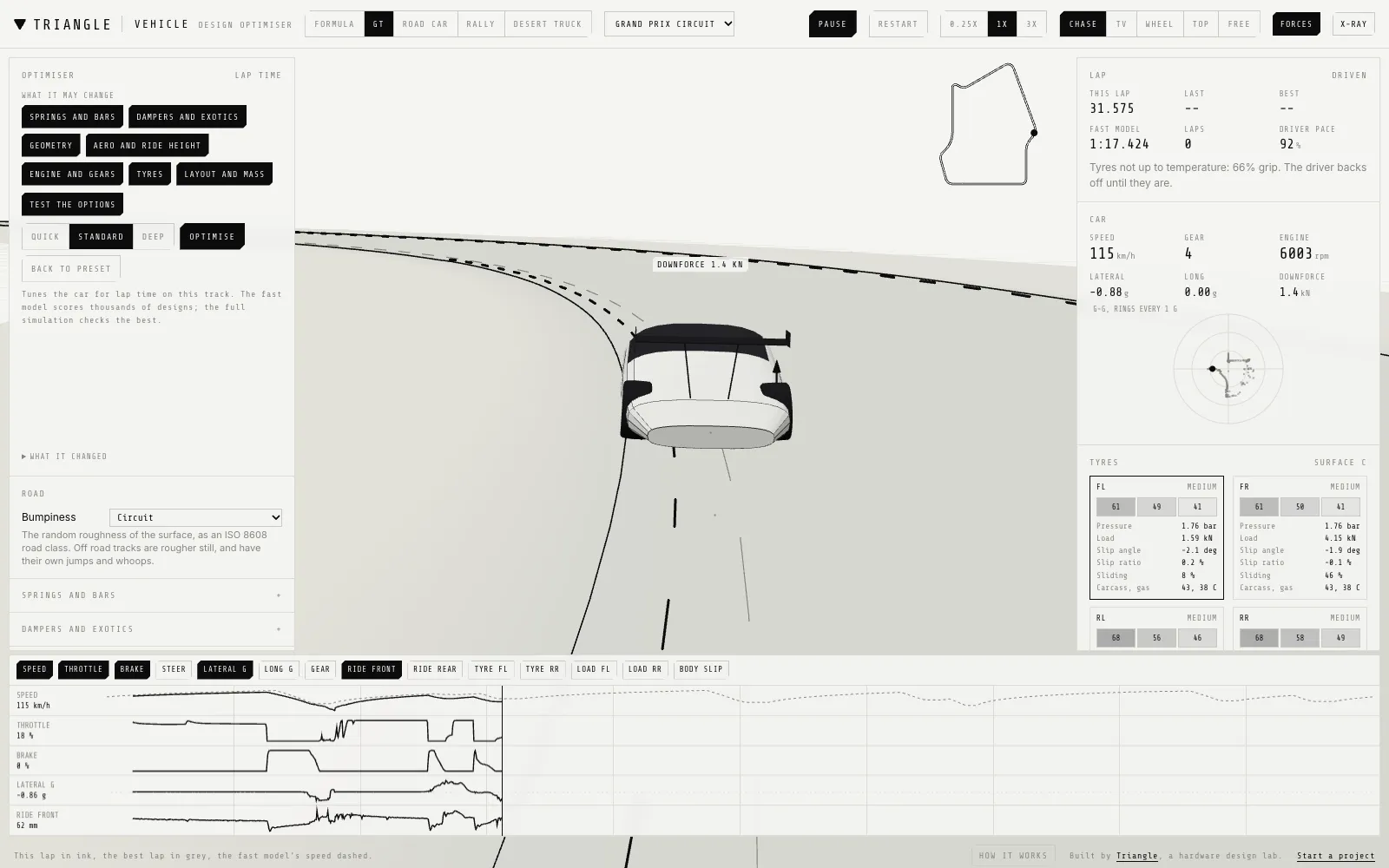
Pick a car and a track. A driver learns the lap in a full vehicle simulation, then an optimiser redesigns the car for lap time: suspension, aero, engine, gearing, differential, tyres and weight. Five vehicle types, from a formula car to a desert truck, on five tracks from a smooth circuit to soft sand.
Run itvehicle.triangle.info
What it is
The car is a six degree of freedom body on four corners, stepped at 1 kHz. Its suspension is synthesised from engineering targets and then solved as a real linkage: double wishbone, MacPherson strut or a solid axle. Each tyre is a flexible carcass of three ribs with brush forces, heat and inflation pressure, and on soft ground it sinks into the soil.
The optimiser needs thousands of lap times, more than the full simulation can give in a browser. So it searches with a fast lap model, about 17 ms a lap, settles the discrete choices (suspension type, differential, drive layout, compound) in a tournament, and then drives the best design in the full simulation, which has the final say.
What it found
- The optimiser finds any gap in a model at once. Its first GT run put the tyres at their widest, because width cost nothing. Width now costs mass, rotating inertia and drag, and the racing classes fix tyre sizes, as real series do.
- On the GT car, 2,000 designs in 32 seconds on one core took 3.1% off the lap in the fast model and 1.2% off the best driven lap. It locked the differential, added a stiff rear third spring, raised both roll centres and took wing off for less drag.
- The driven gain is less than half the fast model's. A steady state model overrates changes that help in equilibrium and cannot see transient costs, which is why every result is driven before it is trusted.
- Cold slicks are slow. Without blankets a GT car loses about a third of its grip on the out lap and needs two laps to bring its tyres in.
- On gravel the hands matter. Snapping the steering to close a line error spins a rally car; limiting the steering rate took it from nine resets in three laps to one or none.
How it is built
Written from scratch in TypeScript and three.js. The physics and the lap model have no browser dependencies and run headless exactly as in the browser, which is how every car is driven on its home track before release. The tyre is checked against a published Magic Formula data set, within a few percent on cornering stiffness and peak grip.
The numbers
The cars and tracks are generic, not real ones, and the lap times are this model's. Masses, aero maps and engines are engineering estimates for each class.
Run it at vehicle.triangle.info