What it is
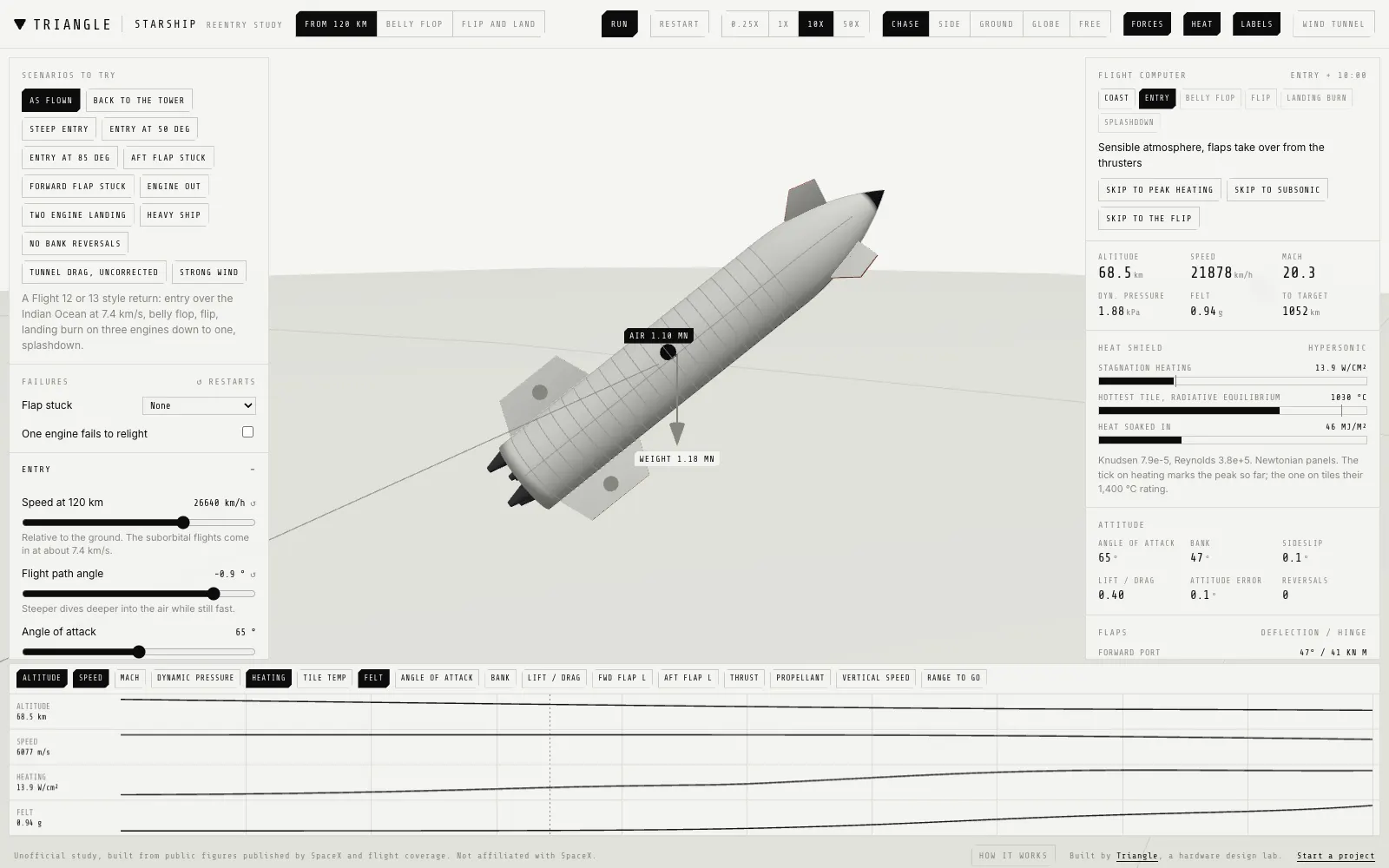
The ship is cut into about 1,800 panels. Each step, the force on every panel comes from the flow regime it is in: free molecular flow at the top of the atmosphere, Newtonian theory through the hypersonic part, and below Mach 1 a table from a lattice Boltzmann wind tunnel run on the GPU around the same geometry.
A flight computer flies it: entry guidance that predicts the rest of the flight every two seconds and banks to hit the target, an attitude loop that shares the work between the four flaps, the thrusters and the engines, and a landing burn that relights the engines and drops them one at a time.
What it found
- The nominal run lands within about 20 seconds of SpaceX's own Flight 13 timeline at every event, from the transonic point to splashdown.
- At entry angles the ship is stable in pitch but unstable in yaw, and below about 50 degrees angle of attack it cannot be trimmed at all.
- Rolling a belly flop does nothing: a cylinder in crossflow makes only drag however it is rolled. To move sideways the ship has to turn its axis towards the target and pitch off broadside.
- Flipping at full thrust throws the ship about 110 m/s sideways along its nose. At minimum throttle until the nose is past 60 degrees, it is about 20.
- The wind tunnel cannot reach the real Reynolds number, and it shows: the hull comes out with more than twice the drag the real ships' fall speed allows. The study corrects for it, says so, and lets you switch the correction off.
How it is built
Written from scratch in TypeScript and three.js. The physics has no browser dependencies and runs headless, which is how every scenario is checked before release. The wind tunnel is a separate page that runs the solver live at any attitude.
The numbers
Unofficial. Built from figures SpaceX publishes and from flight coverage; masses, flap sizes and the centre of mass are published third party estimates. Not affiliated with SpaceX.
Run it at starship.triangle.info