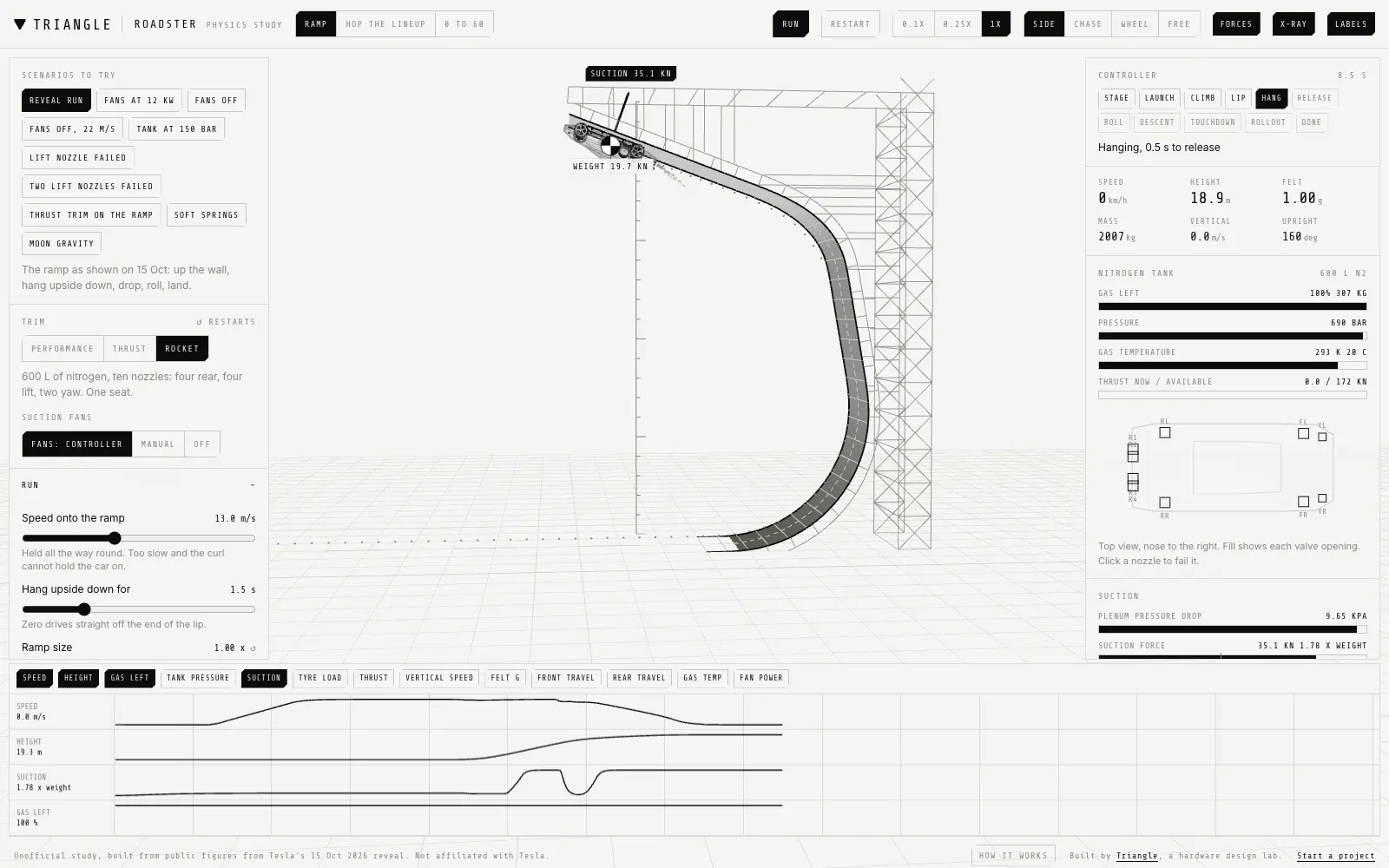
What it is
A six degree of freedom body on four double wishbone corners, with the suspension geometry solved through its travel, tyres, a suction floor with skirts that seal or leak, and ten cold gas nozzles fed from a 690 bar nitrogen tank.
A controller drives it: speed and lane keeping up the ramp, suction to hold it upside down, then a descent planned for thrust that fades as the tank empties, and an allocator that shares the work between the nozzles.
What it found
- 80 kN and five seconds of boost cannot both be true for a 200 litre tank. At 80 kN it empties in under a second.
- A flat floor cannot seal against a tight curve. Through the curl of the ramp it is speed that holds the car on, not the fans.
- Nitrogen at 690 bar is strongly non ideal and cools as it expands. After about a third of the gas is used, thrust is down to roughly 40%, so the landing has to be planned for fading thrust.
- With one lift nozzle failed, the car can still roll hard one way but can barely stop the roll. The controller has to choose the direction it still has authority for.
How it is built
Written from scratch in TypeScript and three.js, stepped at 1 kHz with a 200 Hz controller. The physics runs headless too, so every scenario and failure is flown before release.
The numbers
Unofficial. Modelled on what Tesla showed on 15 October 2026, built from those public figures. Not affiliated with Tesla.
Run it at roadster.triangle.info